
The New Era of AI Search & How AI Finds Your Business
What if your next customer never visits Google?
Imagine a business owner asking ChatGPT:
What's the best digital marketing agency for SEO and AI automation?
Or a startup founder asking Gemini:
Recommend agencies that specialize in AI-powered marketing.
Or someone using Perplexity asking:
Which companies are experts in performance marketing and automation?
If your business isn’t mentioned in those answers, you’re invisible to a rapidly growing audience—even if you rank on Google.
Welcome to the next evolution of digital marketing, where AI assistants are becoming the first place people go for answers.
For years, businesses optimized their websites for search engines. Today, they also need to optimize for answer engines and AI-powered assistants.
This shift is changing how customers discover brands, compare services, and make purchasing decisions.
In this guide, you’ll learn how modern AI platforms discover information, why some brands appear in AI-generated answers while others don’t, and how to prepare your business for the future of search.
Search Has Changed Forever
For over two decades, the customer journey looked something like this:
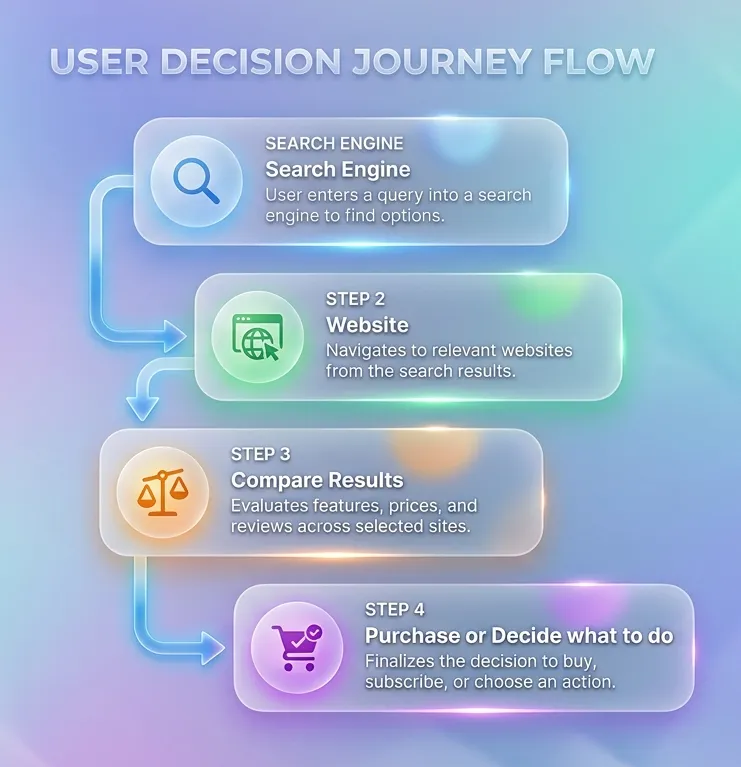
Today, that journey is evolving.
Instead of scanning ten blue links, users increasingly rely on AI-generated summaries and recommendations.
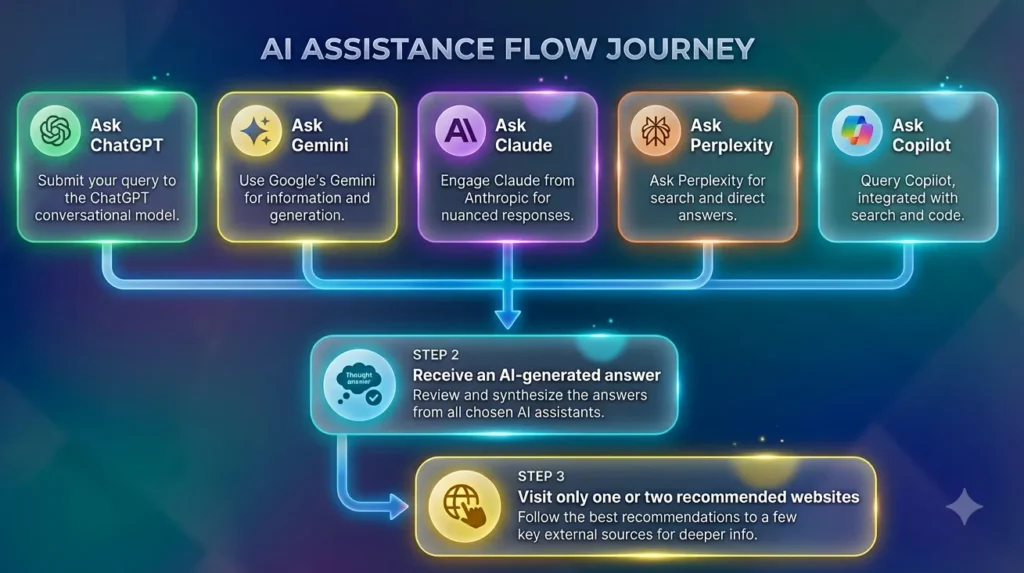
This is one of the biggest changes in digital marketing since Google transformed web search in the early 2000s.
From Search Engines to Answer Engines
Traditional search engines help users find information.
AI assistants help users understand information.
For example:
Traditional Google Search
Query
“Best CRM software for startups”
Users receive dozens of links and compare them manually.
AI Search
The same query in ChatGPT, Gemini, or Perplexity typically produces:
- A summarized comparison
- Pros and cons
- Pricing overview
- Recommendations
- Sources or citations (depending on the platform)
The user often gets the answer without opening multiple websites.
This behavior is commonly referred to as zero-click search, where users obtain the information they need directly from search or AI-generated summaries.
Meet the New AI Search Ecosystem
Many businesses assume “AI search” means ChatGPT alone.
In reality, several AI platforms are shaping how information is discovered.
ChatGPT
ChatGPT has become one of the world’s most widely used AI assistants.
With ChatGPT Search, it can answer current questions by retrieving information from the web while also drawing on its trained knowledge.
Businesses that publish clear, trustworthy, and well-structured content have a better chance of being referenced when relevant.
Google Gemini
Gemini is deeply integrated into Google’s ecosystem.
It can leverage Google’s search technologies, knowledge systems, and AI capabilities to provide comprehensive answers.
Because of this integration, Google’s emphasis on high-quality content, expertise, and structured information continues to matter.
Claude
Claude, developed by Anthropic, is known for handling long documents and nuanced reasoning.
When web search is available, Claude synthesizes information from reliable sources rather than simply listing webpages.
This makes clear explanations, authoritative writing, and original insights especially valuable.
Perplexity AI
Perplexity has gained popularity because it cites its sources directly.
Users can immediately see where information comes from, making transparency one of its biggest strengths.
For businesses, this highlights the importance of publishing content that is accurate, well-structured, and worthy of citation.
Microsoft Copilot
Copilot combines Microsoft’s AI capabilities with Bing’s search index and Microsoft services.
It is increasingly used within Windows, Microsoft 365, and Edge, expanding how users discover information.
Google AI Overviews & AI Mode
Google has introduced AI-generated summaries directly into search results through AI Overviews, with AI Mode expanding conversational search experiences.
Instead of clicking multiple pages, users may receive synthesized answers at the top of the search results, often with links to supporting sources.
This means your content needs to be useful enough to be selected as part of those summaries—not just rank on page one.
Does AI Rank Websites?
One of the biggest misconceptions is that ChatGPT or Gemini “rank websites.”
They don’t—not in the traditional search engine sense.
Search engines rank webpages.
AI assistants generate answers.
To produce those answers, they may reference:
- Trusted web pages
- Official documentation
- Knowledge graphs
- High-authority publications
- Structured websites
- Reliable public information
- Real-time search results (where supported)
The goal isn’t simply to appear at the top of search results.
The goal is to become a trusted source that AI systems can confidently reference.
Where Does AI Get Information?
This is one of the most frequently asked questions by businesses.
The answer varies depending on the AI platform and the nature of the queries of the users. AI engine decides what technique or algorithm should be chosen for this type of query. Sometimes generative AI engines use Retrieval Augmented Generation (RAG) framework to decide AI about which pages to search and cite.
RAG is used selectively, not universally — by systems (and within a single system, for specific query types) where grounding in current or private data materially improves accuracy.
ChatGPT
When using ChatGPT Search, responses may be informed by:
- Publicly available web pages
- Publisher partnerships
- Official websites
- Structured online content
- Reliable reference sources
It may also cite the sources used for current information.
Google Gemini
Gemini benefits from Google’s broader search infrastructure, including:
- Google Search
- Knowledge Graph
- Structured web content
- High-quality indexed pages
Microsoft Copilot
Copilot relies heavily on:
- Bing Search
- Microsoft’s search index
- Authoritative websites
This is one reason submitting your site to Bing Webmaster Tools remains valuable.
Perplexity
Perplexity performs live web retrieval and displays citations prominently.
If your article is comprehensive and authoritative, it has a greater chance of being referenced in relevant answers. See how does Perplexity work when we ask a question.
Claude
Claude focuses on synthesizing information from trustworthy sources and, when web access is enabled, can incorporate recent information into its responses.
Why Some Businesses Appear—and Others Don’t
Imagine two marketing agencies.
Both have attractive websites.
Both offer similar services.
Yet one is frequently mentioned in AI-generated answers, while the other is almost invisible.
Why?
Because AI evaluates more than keywords.
It looks for signals of trust, expertise, and relevance.
Some of those signals include:
- Well-structured content
- Clear explanations
- Consistent branding
- Author credibility
- Original research
- High-quality backlinks
- Reliable citations
- Topical authority
- Positive reputation across the web
Think of AI as an experienced researcher.
Before recommending a source, it looks for evidence that the information is reliable.
The Biggest Mistake Businesses Make
Many companies still believe SEO is about publishing as many blog posts as possible.
Quantity alone no longer builds authority.
A website with 500 shallow articles is often less valuable than one with 50 comprehensive, well-researched resources.
Modern AI systems favor content that answers questions clearly, demonstrates expertise, and provides genuine value.
Publishing for algorithms is no longer enough.
You need to publish for people—and make it easy for AI systems to understand why your content is trustworthy.
AI Doesn’t Understand Keywords the Way Humans Think
Traditional SEO often focused on repeating exact phrases. Modern AI understands meaning. For example, these queries are closely related:
- Best SEO agency
- Digital marketing expert
- Search optimization company
- Performance marketing services
Instead of matching only keywords, AI recognizes the relationships between concepts.
This is why semantic SEO and entity-based optimization are becoming increasingly important.
We’ll explore these concepts in detail in Part 2.
Key Takeaways
The future of online visibility is no longer limited to ranking on Google.
Businesses now need to earn trust across an ecosystem of AI-powered assistants, including ChatGPT, Gemini, Claude, Perplexity, Microsoft Copilot, and Google’s AI-powered search experiences.
Rather than asking, “How do I rank #1?”, a better question is:
“How do I become a trusted source that AI wants to recommend?”
The answer lies in building authority, publishing valuable content, organizing information clearly, and creating a digital presence that machines can understand as well as humans.
That is the foundation of AI Visibility.
Coming Up in Part 2
In the next part of this series, we’ll dive into the practical side of AI visibility, including:
- A practical AI Visibility framework you can start implementing today
- What is Entity SEO, and why are keywords no longer enough?
- How AI citations actually work
- The role of Schema.org and structured data
- Building topical authority that AI can recognize
- Why E-E-A-T matters more than ever
- Real-world examples of businesses consistently referenced by AI